REDRESS
REDRESS
2021 – 2025
The challenge
Severe stigmatising skin diseases most often affect people who are poor, vulnerable and marginalised, especially where health systems are under resourced and fragile, including Liberia. Stigma linked to these highly visible conditions can drive social exclusion and psychological distress, alongside morbidity and disability.
Improving fair access to services is central to universal health coverage and progress towards the Sustainable Development Goals, and it needs action beyond single-disease programmes so that no one is left behind. Integrated health system approaches to managing skin diseases have been proposed as part of the solution.
Liberia is one of the first countries to develop a national integrated approach to managing severe stigmatising skin diseases, using a combined local approach for diseases with signs on the skin, including lymphatic filariasis, leprosy (Hansen’s disease), Buruli ulcer, yaws and onchocerciasis. There is limited evidence, however, on patient knowledge, priorities and experiences, and on the equity and effectiveness of the current approach.
Our approach
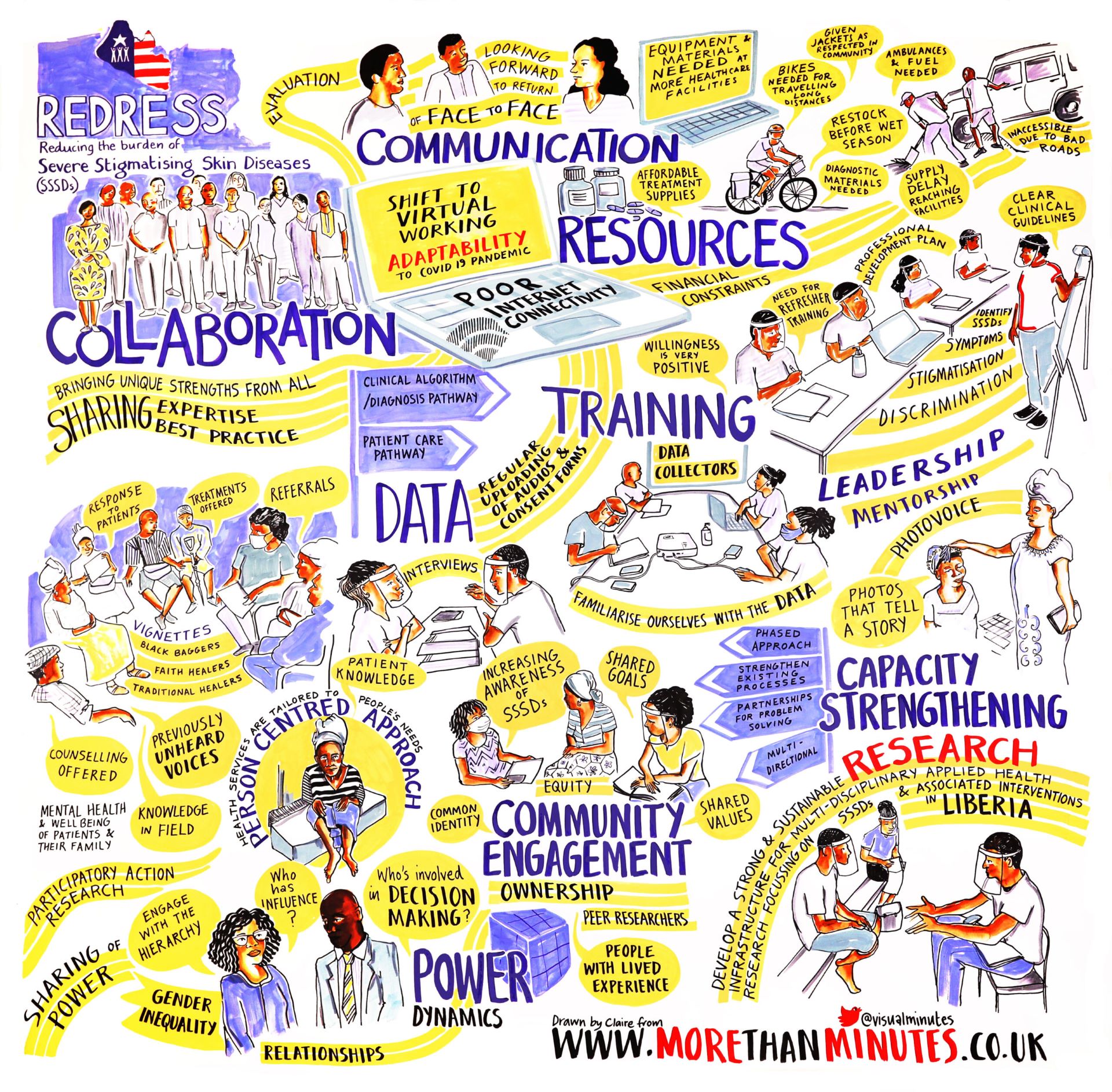
REDRESS uses a person-centred approach to evaluate, develop and adapt health systems interventions for the management of severe stigmatising skin diseases in sub-Saharan Africa. We focus on what people living with these conditions, their families and health workers say they need, alongside the realities of delivering care in the health system.
We do this by:
- Identifying strategies to detect, refer, treat and support people living with severe stigmatising skin diseases that are acceptable, affordable and sustainable, especially for the most vulnerable.
- Designing and testing health systems interventions that respond to biomedical needs and social support needs, based on the priorities of persons living with these diseases, families and providers.
- Enhancing quality and equity so that all persons living with severe stigmatising skin diseases can receive essential, effective and affordable treatment, care and support at individual, family, community and facility level.
- Putting persons affected, health workers and communities at the centre of the programme. Our research draws on participatory action research, which challenges power structures in the design and development of interventions.
REDRESS follows five connected phases:
- Formative research – evaluating existing integrated approaches to early detection, referral and treatment.
- Planning – co-creating new interventions and adapting existing ones with health system actors and people affected by stigmatising skin disease.
- Action – implementing co-created interventions through existing health systems and community infrastructure.
- Observation and reflection – evaluating intervention bundles and making recommendations for quality improvement and scale-up of integrated interventions in Liberia.
- Knowledge translation and policy change – working throughout the programme with the Ministry of Health to scale up and embed successful interventions within routine health systems management, and to make recommendations for integrated management across the West African region.
Impact
REDRESS aims to develop knowledge with regional and global relevance on treatment strategies that are affordable, timely and appropriate, while also reducing stigma and addressing wider social issues for vulnerable populations.
In Liberia, we work towards stronger, more responsive systems that bring together the elements needed to support people and families affected by severe stigmatising skin diseases, including trained health workers, active case detection, timely diagnosis and confirmation, and holistic treatment that includes mental health support.
By working with the Ministry of Health to scale up and embed successful interventions, we aim to support integrated management of severe stigmatising skin diseases in routine care, and contribute to fairer access to services as part of universal health coverage.