LSTM Leverhulme Lecture 2022 – A systematic approach to addressing pandemics and epidemics
- Event
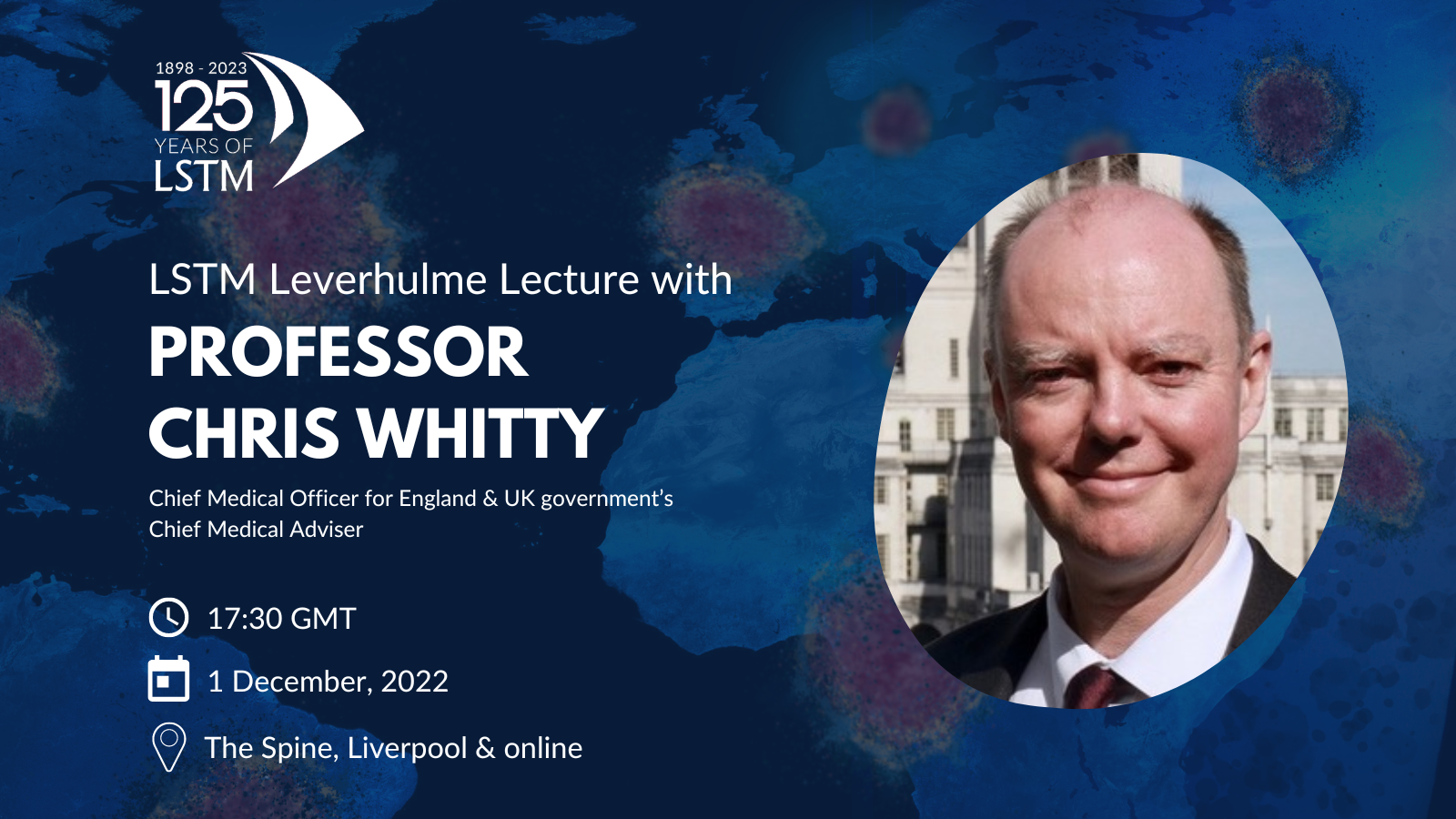
Thursday 1 December 2022
As part of LSTM’s 125th anniversary event series, we were delighted to welcome Professor Chris Whitty, Chief Medical Officer for England & UK government’s Chief Medical Adviser, as special guest speaker at our annual Leverhulme Lecture.
You can watch her lecture in full by visiting our YouTube channel or by watching the video below.
[Music] so good evening everybody and particular
Welcome to our honored guest Lord left hand and hi Sheriff it’s a real pleasure to see you all here today to um hear the
leaving Hume lecture for 2022 uh and to welcome Chris witty Professor Chris witty to give that that lecture
um I know I think Chris has become a very familiar faced us all on the television
in the last couple of years and not something he’s always enjoyed but I think we all know him in some ways but
maybe some of you don’t know his previous history and Chris trained in medicine at Oxford and in fact as I got
to a number of different qualifications in in medical law in economics and also
an MBA uh but at his heart he is an epidemiologist and he’s a particularly a
malaria epidemiologist he spent many times many years working with the opposition the London school
um and we know we try not to hold that against him and was the the malaria or the epidemiologist for the American
malaria Reference Laboratory uh for a number of years and he’s had many collaborations with with a number of
people in the room and his heart I think is in Africa and in tropical medicine as
much as it now is in government um in 2009 he became Chief Scientific
Advisor to uh to different at that point now fcdo and then subsequently to uh
Department of Health dhsc in around 2015 and while he was there he was involved
very heavily in the response to Ebola uh and uh was enormous support to the chief
medical officer at that point Sally Davis who freely admitted as a hematologist that this was not her of
expertise and then I think um when he moved to the Department of Health for
lstm one of the most important things he did was to establish the global Health arm of nihr the National Institute of
Health research that Global Health element of nihr has grown substantially it’s been incredibly important to lstm
LS team has actually been one of the major recipients of nhr global Health funding and he’s continued to shape and
influence that to I think a very a very important element in the UK actually in
fact internationally International Global Health Arena and something I think that is is really remarkable
and then of course he became CMO in late 2019 no idea around the corner of what
was going to hit him but it’s difficult I think to imagine anyone who could have led us through those difficult times in
such a such a way and with such bravery and such intelligence and I think we all
are in a huge a huge debt for what he did for us over the last two years and there was no one better I think to talk
about epidemics and pandemics today Chris he said Delight
foreign
[Applause] at the end look I I I it’s a real
pleasure to be back in Liverpool I spent a lot of my time when I was a proper tropical doctor coming and going
you know brilliant scientists here working with colleagues in Malawi when I was a doctor out there at the Malawi
unit with many uh fantastic Liverpool colleagues so it’s really nice to come
back and repay some of the huge debt I owe this school um I thought it was worth talking about
this uh problem partly because um this is something which has obviously been very topical over the last uh two
and a half years but also because this is something which the Liverpool school has contributed hugely to over its 125
years of history and therefore it’s sort of a point where uh interests collide
um and I’m going to start off just making a few comments about pandemics and where they differ from epidemics and
that in the short uh the short answer is not a lot actually except as I come on to in terms of the
ability of the International System to collaborate where it makes life a lot harder but much of the science is the
same but I think it is worth thinking about a few pandemics and we don’t have very many of them fortunately so in the
last 100 years we’ve only had two pandemics that were on the scale of
covid there was the 1918-19 flu h1n19 flu pandemic I’ll talk
about that briefly and then there was HIV and then there have been some much
smaller flu pandemics three slightly smaller fluid dynamics which didn’t have the same scale but we therefore have to
look to history for pandemics in a way we don’t do for most areas of science because they don’t happen that often so
it’s worth really starting with playground is definitely not the first pandemic but it was probably the one
which really it seared itself into human thinking plague when it hit Europe and it was a
worldwide disease spread originally from parts of Asia was estimated to have had
a really massive impact on global global mortality and probably somewhere between
30 and 60 percent of the entire European population died as a result of this so
it was a huge impact on society so first thing pandemics can be really
massive but then the second thing is that the risk of a Play Pandemic is now zero and
the reason for that uh is that medical science moves on so this is these are
the two in a sense those are the two sides of the equation
cholera was probably a pandemic that is worth thinking about because that was the one which led to the creation of
Public Health as a discipline in this country it also led to the creation of my road as chief medical officer essentially it’s but its most important
area is this is the first pandemic that was really studied scientifically and the person who led that was this
gentleman uh Jon Snow a different one to the Game of Thrones one as you will see and here by a variety of ways actually
looked at this and realized this was coming from a source and that Source was contaminated water and if we could
improve basically stop human feces getting into water these problems would
go away and that was the first really big scientific advance
scroll forward a bit in time and I’m skipping over some other pandemics to be clear uh to 1819 uh flu pandemic this is
really the first pandemic of what we would consider the modern era and I wanted to make a few points about this
the first one is on the left here these are the deaths in the USA from all
the wars that the US fought over the entire 20th century so that’s World War One World War II Korea Vietnam more
people died in one year from that flu pandemic than all the people who died in those Wars
firstly an astonishing number but secondly prior to covid most people knew
almost nothing about it in society despite the fact this has killed as many people as the first world war or more
which almost everyone learns about for weeks at school so interesting how pandemics kind of
drift away from Consciousness and I think there are a variety of possible reasons for that
but it probably kills somewhere between 50 and 100 million people and remember the population of the world in those
that era was much smaller so as a proportion that was actually a very significant hit even relative to covid
Kobe the pandemics can also be very sudden and I think this is uh Illustrated well by the that pandemic so
remember that in 1918 uh it was you know the USA is a big place uh cars were
relatively fewer uh planes hardly used at all and yet in the USA when it was
introduced on in the east coast uh around about um uh September the 14th it had spread
over the entire continent by October the 5th so that’s an idea of the speed of it and
then in terms of how sudden the impact is you can fairly easily tell from that
graph which was the month where the impact occurred so incredibly concentrated in time very rapid over
space so you don’t have much time to react the idea that you can somehow rather react uh you know in into the
ramp up a reaction over many months is clearly not realistic for this kind of pandemic not all work the same way
and then covered which I’ll come on to at the end I’m not going to actually go through it in great detail because all of you are now experts in covid but just
to acknowledge that kovid also moved out quite considerable speed uh when it uh
when it first emerged from a relatively small outbreak uh in at the beginning of
January uh all the way through to uh what happened subsequently this is a map
of China now you so then people say well okay let’s
just predict these pandemics and epidemics and the answer to that is good luck because you’re not going to be able
to our ability to predict pandemics and epidemics is extraordinarily low and in my view always will be they tend to come
from a blue sky they tend to be unpredicted uh except by people there’s always lots of people predicting
pandemics and the one person who accidentally got something right would always say I’m absolutely brilliant and I was but actually it’s not true the
sensitivity and specificity of prediction is extremely low and the reason this is important is every month
I will get David will get many of you will get into our emails through ProMed or other other things who reporting
outbreaks which could turn into an epidemic and in theory could turn into pandemic but they don’t
so in the last months I I think I received 15 which were of importance of
which three were of an unknown cause meaning you kind of can’t tell the risk so just to give a few examples recent
one’s xdr typhoid in in Pakistan uh cholera in several different places but really are bad outbreaks in Yemen and 80
for different reasons play in Madagascar monkeypox now mpox which I’ll talk about
briefly later MERS a big worry every time there’s a Hajj I think quite seriously about this this has got a much
higher mortality rate than kobit had Ebola DRC several outbreaks recently and
Uganda an ongoing one of a slightly different form of it and that’s just recent and and there are very many of
these so they happen the whole time and it is also important to recognize
that many of the impacts of epidemics and pandemics are not just on the medical side not just in people dying or
being seriously injured by them they can also have very big societal impacts and
I’m just going to take economics because you can put a number to it this is the SARS uh epidemic it occurred
between November 2002 and July 2003 so for about a year in that whole time in
which had Acres of print large numbers of front pages I’ve just put a few uh a
few of the kind of front pages we tend to get with these the total number of cases globally was
less than ten thousand and the total number of deaths was less than a thousand
because of the worry this led to an almost complete closure of the economy in many countries in in East Asia in
particular and Canada to some extent closure of a large part of the uh of the um or several Industries including the
airline industry and according to uh very authoritative views uh cost the global economy probably about 40 billion
that’s just an idea for what we would now consider to be a relatively modest epidemic but you we just didn’t know
which way it was going to go so the global uh and societal impacts can be huge and obviously the impacts in covid
are going to be massive over time and well outrun the period in which people
are still dying in very large numbers from the disease although the disease is not I think as everyone recognize is
going to go away so that’s really the kind of that’s the problem statement so what can we do
about it and I think my main thesis here is that the key thing to do is if we deal with an epidemic or a pandemic and
a pandemic is a large epidemic for practical purposes we need to be very systematic about how we approach it and
I think that there are essentially five questions we need to ask which then drive what we then do now there are many
people in this audience who could give the same lecture and we give a slightly different uh ordering and a slightly different approach that’s absolutely
fine I’m giving my view I think you have the right I have the right to give it but I also accept there are many other people who’ve also got the right to give
theirs first thing and I’ll go through each of these mortality or and the age structure
of severity of disease that has a big impact on what we do second one is is there a Treatment
available if no move on and try and get one try and get one very
important part of it third question is there a vaccine available if not move on but try and get one very quickly those
two things are going to be necessary fourth one is a force of transmission
the r which is a concept which I thought was quite difficult to teach but actually the general public picked it up
in about three and a half seconds which is really very useful but a very important Concept in epidemiology and
finally the and probably most important in my view the root and to some extent the duration of transmission but root of
transmission is absolutely critical and just uh to preempt what I’ll say
later just remember that the last big pandemic we dealt with was HIV
young adults sexual some intravenous all the things we’ve done for covid would
not have worked against HIV all the things we did for HIV wouldn’t have worked against Kobe so the idea that
somehow rather by doing one pandemic perfectly you’re going to be absolutely terrific at the next one is clearly uh
optimistic so let’s start off with mortality and this is measured various ways case
fatality ratio infection I’m not going to go through the technicalities but they they vary very widely by epidemic
and just to give a few examples HIV which many people of my generation David’s generation he’s obviously older
than me and dealt with at the early part of our career at the point we were dealing with
it 100 mortality so if you know that had a very different kind of feel to it Ebola uh um uh in it
certainly in the pre-vaccine stage uh mortality rate 60 70 would be typical
it’s a bit less if you treat it really well but in you know typically treated around that smallpox uh MERS roughly 30
mortality H1N1 uh the big flu pandemic of 2018. big important point of this uh
two to three percent so you can have a much lower mortality rate but if you infect a very large
number of people the impact on society can be just as great so what you got is you know the two big ones there so far
are HIV huge mortality significant numbers of
people infected but not in Northern countries very large numbers if you’re
in southern Africa up to 30 to 40 percent of the population infected absolutely catastrophic for those of
those who can remember that era and covid which was sort of literally around one percent
slower now but also important to realize that how well you treat something has a big
impact on this things like nutritional status have a big impact on this so we think in the UK of measles as an
unpleasant occasionally severe but generally rarely fatal disease if you’re
talking about an epidemic in parts of Africa where there’s low vitamin A Levels people got
relatively low nutritional status the mortality rate for this can be five to ten percent even higher in some
situations so these things are not fixed but there’s usually an upper limit
how high the mortality rate will Define what you do and so also will the age
structure so there is a legitimate debate uh with covid for example about
what we should or should not have done with schools um if it had been flu
which actually has a very significant mortality in children that would have
been a very different kind of discussion and rightly so so it’s not just how many
people die it’s also the age structure of people dying and if we’d had the H1N1
flu uh H1N1 pandemic from uh 28 to 1918
uh quite a large number of young adults also died so that again would have led to a
different situation would we have been able to get people to go to work to stack the shelves if this was the situation in supermarkets healthcare
workers would have gone to work but people who were doing transport people who are doing other vital Services might
have thought twice about it and that I think you know that that the age structure therefore has quite significant impact so of course HIV
absolutely targeted at this age group people often think that something which
is more transmissible is going to be less uh virulent less dangerous actually
that is not the case I mean it may be the case but it isn’t necessarily the case the key things with this in my view
is that you just have to think when you first since start think about mortality is uh think about it in this grid
if it’s high transmission and high mortality we’re in deep trouble we’re going to have to do something really
really fast and there’s going to be massive panic and there’s going to be real difficulty dealing with it High however can be quite low in the
kind by the kind of numbers I’m talking about so as I say the H uh yeah so three percent for the 1918 uh flu pandemic
if you’ve got high transmission but very low mortality and we had the last pandemic we had was an H1N1 2009 which
had very low mortality then you can usually it’ll go through yes you’ve got to do something about it but the
impact’s going to be quite modest equally if you’ve got very high mortality and low transmission you
generally don’t have to have to do a lot about it so most of the avian flues we’ve had to date to date mind
the we have to be very very cautious there’s a big there’s a big pandemic in birds not in humans but for most of them
very significant mortality 30 maybe of people who get them but you pretty well have to do maths to beat resuscitation
of a Dying Swan to actually get them so you know this is not immediately going to be a big risk to the human population
of course if they’re none of those not worth worrying about at all but you shouldn’t assume these are all
the same disease remember this is all flu you shouldn’t have seen assume that just because something has got high
mortality it’s going to have low transmission that may not be true so yeah we could get like we could get worse than we’ve had uh with these
so that’s mortality treatment um uh if you can’t stop the pandemic or the epidemic and you may well not be
able to uh then you may be able to stop them dying and if you’ve got something off the shelf that’s absolutely
brilliant generally speaking if we had a big epidemic of uh any parasite I can
think of we will have a drug I’ve got another brilliant drug for example sleeping next sickness this week in fact
so you know that’s in good we’re in good State almost certainly with the new bacterial epidemic or pandemic we would
be able to get an antibiotic that works it will almost certainly come from animals with a certain almost certainly something to do about it you may be able
to get antivirals or may not we’ve seen this recently and then there are disease specific things that may not be
infection related at all vitamin A in measles is very effective for example and if you think about what we did in
covid using steroids proper use of fluids proper use of supported care
proper use of oxygen have very big impacts on mortality so it’s not always the thing which kills work
so treatment’s an important area but I’m not going to go through that in great detail and then of course the vaccine ever since uh Jenna we’ve always thought
the solution to a any pandemic or an epidemic is a vaccine actually there are
very many serious academics and pandemics for which we either have got moderately bad vaccines or no vaccine at
all HIV would be a no vaccine at all disease for example at this point so if
you’ve got an outbreak of something like yellow fever measles polio smallpox we have vaccines we can just go ahead we
can manufacture we know where they are they work they’re great we may have variants of things like flu so that
takes us a bit longer the lead time would probably be about three to four months for one of these but we know we’d
like to get something that’s at least moderately effective it may not be brilliant they vary a bit for new disease a vaccine will usually
take years now we have been unbelievably lucky with covid that the vaccine was able to be produced
for a variety of reasons and worked extremely well after a relatively
shorter gestation period I remember the large number of years of science had gone into it before that this is not completely de novo but we could easily
be in a situation and certainly my advice to ministers at the beginning perfectly open about this was I think
this will probably take years it may be a small number of years and we certainly can’t assume that the vaccine Cavalry
will be over the over the over the hill in nine months time which is what we saw in this situation so we have to be
careful that we don’t over we don’t not you learn the wrong lessons here and
then there may be some which we never get them at all an HIV uh extremely difficult no haven’t really achieved it
malaria pretty difficult haven’t achieved a good vaccine moderate vaccine after Decades of trying
when we’re doing vaccines we may however not have very many of them and I think uh we you know again the first thing
people assume is let’s vaccinate the whole population actually if you don’t have very much vaccine or alternatively
you have a vaccine that has got significant side effects then that may well not be the right answer
so uh the the alternative strategy which is quite widely used in a number of situations is something called ring
vaccination which is where you find the people we do this with ebola for example we used to do this as smallpox you find
the person who’s got an infection you find all the people around them and you vaccinate all of them and all of their
contacts and you basically hem it in now the sign that moves incredibly fast with very very low uh symptoms that prove
what’s there like covid that’s not a realistic option but if you’ve got something like smallpox well I mean if you if you know
if someone in the audience had smallpox I would probably be able to think well they might have smallpox from halfway up
the audience and if they were in the front row I could say smallpox or not smallpox from a very nice safe distance and get everyone around the vaccinated
kind of like now uh that’s a realistic option so it depends whether you what the disease is but that you may be able
to do it or there may be only certain groups who are high risk so for example npox at the moment is very heavily
concentrated in relatively discrete bits of the population necessary necessarily always be you can find out who those
people are and just vaccinate those people and you don’t have to vaccinate the whole population so there are certain things you may be able to do
with smaller numbers so those are drugs and vaccines and
finally before I move on to trans Roots the transmission which is the major part of what I wanted to talk about uh the
force of transmission I’m not going to go through this in great detail because I think everybody really does understand
this now but just to say that the you your aim with most epidemics and
pandemics is to get R below one because once it’s below one where one student situation where let for every
case there’s less than one case passed on the epidemic is by definition going
to go away if you can maintain that equally if it’s above one by definition it’s going to continue to increase
exponentially at different rates but it’s going to carry on going up so there’s a huge difference between 1.1
and 0 and 0.99 and obviously the further away you are now with if you’ve got something that’s
got an R of three you’ve got to bring the rate of transmission down three times if you’ve got an R of one one and
a half you’ve got to bring it down half it probably would be safe
there are diseases malaria which is as David said I spent a lot of my life talking about the equivalent of R for
malaria in many parts of Africa is between 100 and 300. so it is quite possible for a disease to
have a huge force of transmission and the idea of putting R below one in a short order is simply biologically
impossible so it is you know again the r does make a very big difference to what
is genuinely realistic and then doubling time to basically tell you how quickly you’re going to run into
trouble R is also very useful not just in telling you what you can do but also in
tracking uh your uh your progress so this is the uh outbreak in Sierra Leone
of uh the very serious epidemic of Ebola that happened uh about in in about five
years five or six years ago and as you can see if you look at the total numbers they kept on going up uh up to
um about December of the first year where we had the very big problem and
people were shouting literally our strategy is failing
because when they didn’t realize that the r was steadily clearly going down and because it’s exponential even if
it’s even if you’re you’re winning things continue to look as if they’re going up and you need to follow the r because the
r tells you what is the point you’re actually winning and from when on things are going to improve so you use the r as
a tool of analysis as you as you’re in Flight as well as a tool of what can we
do right at the beginning so now onto the roots of transmission which is going to be uh most most of the
rest of this talk um knowing the route of transmission of an infection is critical to
understanding how to control it in the early period so essentially with all
epidemics and pandemics the other early period when you do not have a medical countermeasure you don’t have a drug you don’t have a vaccine let’s get onto on
top of it because if you did you just deploy it but if you don’t you need to know the
route of transmission because what you do will then depend on social interventions
for that route of transmission a root a social intervention to try and stop a sexually transmitted infection is
completely different to one to for an oral disease for example which is different again to a respiratory ones
you’ve really got to know this and I’ve just listed I’m not going to read them out some of the infections but the
broadly there are five routes of transmission which are capable of sustaining a serious epidemic they are
respiratory as we just had food and water will be classic but there are many
others touch vectorborne so insects and arachnids
mosquitoes in the main uh sometimes flies sometimes uh sometimes ticks and
sexual people always forget sexual they always think it’s unimportant forget that HIV was the last really serious
pandemic you know basically lots and lots of people have sex otherwise you would not exist it’s kind of there’s a
lot about so it is actually quite an efficient way if you’re an infection of driving yourself through a population
most infections have one dominant root some of them may have a secondary one but if you can get on top of the
dominant one the others generally are not that important yeah
so now let’s go through some example of of a recent um epidemics and pandemics which I and many people in the audience
have dealt with because I think they illustrate the points I’ve been talking about so here’s Ebola uh 2014 in West
Africa the UK in support of doctors and the government of Sierra Leone was quite
heavily involved which is why very many people here will know about this spread really relatively fast despite
the fact this is a touch disease so only by touching someone and generally someone who’s got symptoms can
you catch it you might think well that’s easy just don’t touch anyone but that’s easier said than done and as you can see
it’s still quite an efficient way of getting through the population so the start of the population just
going through the things High mortality over 60 okay so this is a serious issue and at the end of this particular
outbreak uh over 11 000 people sadly died we had no medical countermeasures at
that stage there was no drug vaccine no drug so they were not part of the consideration uh we did get a vaccine
subsequently but not actually in time really to make much difference to this uh outbreak it has been important
subsequently r at that point was somewhere between one and a half and two and a half that means you’re actually in
the positive situation we’re pulling it below one is realistic this isn’t a malaria in central Africa in the rainy
season situation the doubling time was about two weeks that means you actually things are going to move very fast exponentially this is
going to double every two weeks until you do something we knew about the fact he was touch and importantly it was only
infectious when symptomatic so if you basically just dealt with symptomatic people that was like to be sufficient
but also importantly people were highly infectious after they died many infections by the time you die the
infection has gone that’s not clearly true for Ebola so therefore we had to knowing those
things we had to try and work out what we were going to do and it’s therefore a touch disease from symptomatic people
including dead people so uh very important to reduce transmission hospitals when do you touch
people well the answer is you avoid touching people you won’t realize it as an adult you avoid touching people the
whole time you do these complicated dances to avoid touching someone who is not your intimate partner or your
children who do you touch children children touch one another deal sorts of other unspeakable things and you uh touch
elderly people who need who are vulnerable and need help and then you touch for ceremonial reasons shaking
hands and in the case of West Africa for um important funary rights
so healthcare workers very very high risk it’s a touch environment you can’t deal with very sick people without
touching them so we had to reduce transmission there a lot of the transmission was there death and burial
very important area we had to reduce the transmission there very large part of that we had to reduce transmission the
community by saying to people are symptomatic sorry guys you got the symptoms you
could have covered you might not please isolate yourself from the rest of society we’ll try and look after you for that period this is a very dangerous
disease please don’t pass it on people incredibly uh Brave incredibly stoical about this and then he also encouraged
people to do to avoid things like touching but when handshaking you know the Bishops all demonstrated how to Bow
deeply as a way of showing respect to a an older person without actually having to shoot their hand
with all these things we pulled the r below one when I say we I’m talking about the
ceradionian uh population but we humankind but a lot of people tragically
died in that uh in that fight and I’ve Illustrated uh Dr Umar Khan uh at in his
funeral a safe funeral of a very brave man who led the uh initial response in
Syria and Sierra Leone doctor important touch diseases unfortunately
have one very major risk which complicates our way of responding and
that is that healthcare workers will be heavily affected because healthcare workers touch strangers in a way that
everyone who isn’t a healthcare worker does not so it has it it zeros in unervingly on healthcare workers
unfortunately and just to demonstrate how terrible this was all of the people
who are in blue it is what one is the person who introduced this epidemic in Nigeria
imported from Sierra Leone every person in blue was a healthcare worker every person ringed in red died
so touch disease is really dangerous in the healthcare setting and this of course meant we were in a
very difficult position because we’ve seen a rock and a hard place on the response for the sodium and other governments if we responded slowly this
was going up exponentially every two weeks we would very soon get to a point where it spread all across West Africa
including into much less easily uh easy to respond places if it got into areas of major conflict for example
but on the other hand healthcare workers were incredibly high risk of mortality now the courage of the healthcare
workers both in Sierra Leone Guinea Liberia but also volunteers who went out to them cannot be faltered we said to
healthcare workers in the NHS uh we think at the moment there is a
roughly 10 per healthcare worker year chance of you catching infection if you catch it currently the mortality rate is
about 80 percent you’re also going to miss your Christmas and work in very different conditions what do you think guys within 24 hours
we had over a thousand people have volunteered to go so yeah the courage is not is absolutely clear but you have to
train people to operate in dangerous environments you can’t just throw them in and that takes time so you’re always
in this Balancing Act between the speed of the response and the need to protect the people who are actually going to do
the responding you can’t you simply can’t avoid that and if we had delayed as I say I think we were six weeks away
in fact from a situation that would have become unmanageable in West Africa and
if we waited six weeks I think it would have spread all across certainly West Africa and probably more widely
but now however we do have a vaccine but not for all forms so in DRC at the
moment there are several um there are several outbreaks uh we’ve used ring vaccination they’ve been highly effective uh where they’ve been used but
we do also have an outbreak that in in Uganda at the moment which for which with what’s What’s called the Sudan very
into the boat for which we do not have a vaccine so we’re back to square one and because of that it’s taking a lot longer
to clear from Uganda despite many highly competent uh Public Health uh officials
and doctors in Uganda so when you do that you have to rely on social interventions if you don’t have a
medical intervention you have to rely on social so that was Ebola HIV pandemic again a huge pandemic many
people here have worked in that at the point I was working uh in Malawi at the turn of the century uh for example
roughly a third of women of my age had HIV all of them would go on to die just to give her a sense of scale large
numbers of my colleagues died moved really uh quite fast so started the epidemic first recognized
in 81 very high mortality over 99 I’ve said rather generously in fact 100 at
that point medical countermeasures we had no obvious medical countermeasures at that stage we had no vaccine
the r was somewhere between two and five but highly variable in different societies the main route of transmission
was sexual and the main route of transmission in Africa was heterosexual is MSM in uh in Northern uh in northern
northern countries but uh but it was sexual everywhere and a secondary route intravenous but also importantly people
were highly infectious when not symptomatic so just taking symptomatic people out of the equation would not
have dealt with HIV people would be infectious for many years without any kind of symptoms
so we had no medical countermeasure so we had to use social this is the repeated theme of this and the sexual we
tried to change behaviors but changing Behavior sexual behaviors is quite tricky once people have got into a
particular router way of Behaving you can look at those and work out which if any of these posters had an effect on
people’s sexual behavior I can tell you to be confident the one on the right is wrong there are very very many very
faithful people who unfortunately uh died but they’re uh but this was really
quite a difficult thing to deal with and the same was also quite tricky with intravenous drugs because people are
addicted to a highly addictive system so that dominates their thinking
fortunately we did be able to then move on to Medical countermeasures but by fits and starts we never got a vaccine
for HIV but we do give drugs and I’m not going to go through each of these my
point of the comments on the left which you can read is that this was an incremental process it happened over
many years so it wasn’t that we found HIV first described at the beginning of
the 1980s and by 95 we had a really good drug it took two decades essentially until we
had really good drugs and longer until they were rolled out in the countries which actually first needed them so this
was a slow multi-year incremental process
and a lot of that was involved involved reducing price because most of the people are affected with from low-income
countries and there are some reporting stories about how prices artificially essentially maintained uh which are
probably not for this talk fate because we don’t have a vaccine we
are also using drugs to prevent HIV people who can have high risk sexual encounters but also if people are on uh
into retrovirals property control they have zero chance essentially of passing
on that virus to someone else so we’re now using a drug to prevent
so drugs can be used as prophylaxis in an epidemic just as they can be used as a a as treatment
and over time the rate of HIV incidence is going down steadily but very very slowly globally
unfortunately but the rate of people dying has gone way down because once someone’s identified early in their
disease then you can actually move on to treat them highly effectively with very effective drugs which will maintain
their life and in a place which is actually able to maintain this we’re now
in the situation where someone with HIV on treatment has a life expectancy that is identical to people who actually
don’t have HIV at all that’s an astonishing turnaround thanks to Medical Science
and pox uh which was until this week known as monkeypox uh to both touched on sexual I’m just mentioning it in passing
uh because uh it’s something we’re grappling with at the moment a recent epidemic in Europe which was actually
driven a disease that previously had been entirely touched
um but they are touch actually still technically but all in sexual encounters pretty well and just to look at the
demographics on the right what we’ve got is the age bands all the way up the uh
the first big band out is 25 to 34 and on the right is Main and on the left is
women there are no but not no women but there are very very few women this is a very
very specific group and therefore back to who could you know how can you use vaccines you can vaccinate the high-risk
group extremely clearly and you don’t have to vaccinate anyone else and you can still control the epidemic now we
don’t know monkey boxes got monkey box Mbox has gone away for the moment to a large extent it’s not completely gone but it’s way down but honestly we don’t
know why and that’s an important point because we don’t know why something’s gone away you don’t know why it might
come back again so I think we should just keep our eyes open on this
so um that’s uh touch uh um sexual now Vector born epidemics in the UK used to
be common we had epidemic typhus for example killed thousands of people uh in really significant epidemics that was
from fleas plague obviously also fleas and malaria last case similaria
endemically transmitted was in the 1920s but it used to make large parts of east east England extremely unattractive to
live in but around the world very many vectors of different sorts mosquitoes are the
main culprit but sand flies flies of various forms ticks can all uh pass things on and I have a worry after
emitter in the UK about midges which don’t pass on things very much in humans but they do for example in cattle so we
know that they’re capable of being vectors just give the example of uh the in the
mosquito 80s 80s is 80s is highly adapted most of the many of the 80 species to living in urban environments
unlike most other vectors which tend to be more rural so as countries have
urbanized ads are transmitted infections have in fact gone up this is Latin
America and I’ve tried using the example of dengue which is steadily spread through Latin America over the last uh
two decades three decades and the most recent one of this was zika
first described in Uganda in 1947 it then gradually moved across Africa and
then hitchhiked on humans into Asia spread a little bit not huge amount then
hitchhiked over to Latin America and then we had a really very substantial
outbreak of this 80s born disease in Brazil in uh 2014.
and 2015. and this as everyone I think will remember the big problem here is not the
infection itself which is generally pretty trivial small number of people get neurological complications which not
trivial but those Arsenal numbers the big issue was if you were infected in early pregnancy
significant neurological damage to the unborn baby that’s a really serious issue so here is a recent infection it’s
not that it’s newly emerged but newly epidemic suddenly occurred over a very
short period of time and then and you know therefore at the beginning of this
epidemic high transmission about 12 percent of pregnancies in the first trimester were affected by these
neurological complications it may even be longer no drugs no vaccines we did know the route of transmission and we
did know the mosquito species quite early on and there was a bit of sexual transmission as well but pretty
unimportant making it even more of a global problem however was that was the year Brazil was
holding the Olympics so this was potentially given there were large number of athletes and supporters
coming from ads High environments we had a big worry people would come into
Brazil get zika take it back to their country of origin and then we’d have a worldwide outbreak now we didn’t
more through luck than good judgment if I’m honest the Brazilians did a fantastic stance job a fantastic Control job that’s not a Christian of them at
all but actually what saved us was the fact that actually the rains began to stop and the and the epidemic burnt
itself out combination of those two if that had not happened we could have had a much more serious issue with zika than
we did I think zika is still a risk globally and we can’t get a vaccine you
can give to women of reproductive age early enough in my view
it’s quite the potential for these kind of vector born spread so on the left uh it is egypti which is the most efficient
is the maps of where they live as you can say they don’t go up into Europe but 80s Albert pictures the fellow on the
right uh woman on the right actually more accurately uh goes count is already in Europe and is moving steadily
northward as a result of a number of things but climate change is one of them it gets introduced into Britain quite
frequently and then dies out but there will come a point probably where that doesn’t happen in it stays so we
shouldn’t assume this is game over uh in these areas uh waterborne uh disease is now
fortunately limited to places where Public Health has broken down
but they’re still out there so tragic war in Yemen tragic for so
many reasons all wars are tragic this one’s even more tragic for multiple reasons but cholera has complicated this
war very substantially and as you can see very large numbers of children have been infected and of those
a significant number have died that’s basically sort of a breakdown in water and sanitation same’s been true in
Haiti recently due to natural disasters but we’re not completely immune although we are much less prone to oral
transmitted diseases and the last one was actually something which emerged in the UK new variant cjd from BSC and Cattle
reasons for this are complicated and to do with the way in which feed feed was changed in a variety of other areas but
what you have on the left is the BSE incidence and on the right you have the human disease occurring some years later
we are fortunate that this the actual attack rate in humans was relatively low but that was not a given and there was a
very serious worry that we were going to have a large generation particularly of children who were neurologically infected and who are going to get early
neurological disease so this is something which we should not say that the oral has just gone away in high
income countries but is much less common due to proper hygiene proper food production and water and sanitation
so those are the kind of the the roots of transmission and how you deal with them depends on which route of
transmission you’ve got just a few more General points just to wrap up in general our ability to fight
epidemics has steadily improved due to a combination of International Development including here in the UK
so as countries develop less likely and science so all of those are improving
but unfortunately from time to time development goes backwards and the most common situation for that tragically is
war and wall basically can wind back the clock so wherever we get Wars we get
breakdowns and sanitation housing uh vector control programs nutrition gets
destroyed and as a result infectious epidemics will occur as night follows day
breakdown of social norms increases STIs Etc so war is always an incubator
unfortunately of infection and as we all know tragically there’s a war in Europe at the moment which certainly will have
infectious consequences um there is a reason however why the
respiratory infections are the biggest risk and that is because respiratory infections are indiscriminate they are
the most difficult to interrupt all of the other routes I’ve talked about you can basically when you know the route you can find a way to trans interrupt it
respiratory is a lot harder and therefore and the speed of this can be
very rapid so as if you have some a sexually transmitted infection you
generally know who you have passed it on to generally if you have a respiratory infection you
definitely have a high chance you’re not so someone had a highly infected respiratory virus in this audience you
would pass it on to various people without ever them ever knowing who you were possibly and uh and that’s just the
way it is so it’s much much easier to transmit it from random households through random social networks and
therefore it can move very rapidly as I showed with HIV at the beginning the last one we had was H1N1 before
covid it was a very serious pandemic it moved a very substantial speed so on the
top left there is the beginning of April and on the bottom left is May and the
bottom right is July this moved globally extremely rapidly it actually infected very large numbers of people somewhere
between 43 and 89 million people were infected with this so huge infection
rate actually but fortunately the mortality rate for this flu was lower than the average seasonal flu and
therefore the number of people who died was in fact very small here in the UK were you really thinking in the hundreds
to low thousands CDC things overall eight to eighteen thousand deaths wide
estimates of these numbers so that was a near Miss but it’s still spread very rapidly
but it did come on very fast as with previous ones and as with many epidemics there were two waves in the case of the
first H1N1 the 2019 that’s 2000 so the 1919 one it was the second wave that
actually was the one that killed the most people the first wave was actually relatively modest in this case the big
wave was the first wave but it’s not always that way um just a few comments on that
officially in the UK 457 deaths I would say that that’s obviously going to be an underestimate but it wasn’t massive
numbers a vaccine was available but well after the peak so it didn’t really interrupt what happened particularly the
use of drugs in this situation was controversial but it was basically controversial because the disease was so mild
so therefore even very small risks of a drug become unacceptable and rightly
unacceptable if the risk of disease is absolutely trivial if this had been a five percent mortality that that whole
worry about drugs would have gone straight out the window because the risk benefit would be so far over towards
treatment various interventions of call forwards swinging at airports Banning travel closing schools some of them were done
uh probably very few of them made huge impacts on the end mortality basically
because it’s so mild so that was the last one that we had and then we have covid and I’m only going to do three
sides on covered because everyone knows the story but just to go through my structure mortality
uh roughly one percent one to two percent depending whether you’re talking about infection uh initially but very
heavily skewed towards older people relatively low mortality in middle middle aged adults meaning people over
50. some of you can relax and really very low mortality elsewhere except for
people who’ve got high risk drinks but it had no treatment skip on to the next thing we had no vaccine skip on to the
next thing the force of transmission we worked out fairly early on was somewhere
between one and a half and three and a half narrowed it over time but it was in the ballpark of yes you can get on top
of this this is not a Fool’s errand trying to push this below one and the route of transmission was clearly
primarily respiratory but therefore we had two choices which
is do nothing and let it go through the situation or push the r below one by because it’s respiratory very
substantially socially disruptive interventions and that was essentially the choice that Society had around the
world and almost all of the world went in One Direction exactly how they did it varied but the broad Choice was there
now what I put here is the different things we know about it on the top we
have detected cases you’ll see very few detector case at the beginning that’s because we had almost no testing and because of that there were lots of
things we couldn’t do including we didn’t spot the wave that on its way up until relatively uh later than we should
have done I mean we’re relatively meaning probably two weeks but nevertheless it made a big
difference in the middle what we have is hospitalizations two waves in fact the second wave was the bigger wave in terms
of impact on the NHS the the air hospitalization in the second wave was very very substantial and prolonged
um but there were several ones and there’s been a one recently and I suspect we’ll get another one coming up uh over the winter I think that’s not
definite but I think it’s highly likely but the good news is mortality and at
the beginning all we had was social interventions and then from the end of 2020 we had a mix of Social and medical
interventions and drugs that were moderately good like steroids vaccines beginning to be deployed by the by this
year this last year we had vaccines and drugs but we still had substantial force in transmission and now we’ve a highly
immune population but obviously some people are at significant risk and that’s really been the thing
social interventions only mix of Social and medical rely almost exclusively on medical very few people are taking more
than relatively modest uh risk risk reductions they’re doing some at the moment people tend to be cautious
if they go and see their elderly relatives for example and I think rightly um but that is what we will get with all
pandemics so that’s my structure others can take different ones but that I think is how
we as Society need to respond to this thanks very much
[Applause]
so thanks very much Chris for a brilliant talk we’ve got a few minutes for questions I’m afraid we can open
only take questions from within the room and obviously we haven’t gotten that much time so we may not get to everyone
could I please ask that you Australian your questions just to the subject of the talk tonight and if you want to ask
a question stick your hand up we’ve got some microphones all around the room and people will come to you
some of the back thank you when
it’s on lovely thank you when David introduced you he said that your your best skill was as an epidemiologist that
I’d add into that historian as well um I wonder if you can reflect on why we
don’t seem to learn the lessons from history between pandemics
well I think that we need to uh well the first thing is that pandemics happen very rarely
so if you just think about the last hundred years roughly every 25 years has been a
significant pandemic and only every 50 years a big pandemic on average
actually that’s one generation of professionals so basically the people who did dealt with the last one have just about retired by the time the next
one comes along if they were spaced evenly which of course they’re not so I think partly it’s that partly it’s that
they’re so different so people who are incredibly good at dealing with HIV would not have had a particular advantage in dealing with kobit or vice
versa but I think the biggest thing is that people I don’t like spending resources for something which is
intermittent so immediately after a pandemic uh people think yeah yeah never again we’re
gonna we’re gonna keep the diagnostic services good and we’re going to do all that kind of stuff and five years later
there’s big cues in a e and they think really you know we haven’t had one for a while and 10 years later they think this is
ridiculous you’ve got maternity services and difficulty and you can go through the list if you’re the minister what do you do
and that’s the problem is that and then of course when the next one happens everyone says why do they not well the answer is because between those times
huge numbers of other priorities are stacking up and nothing was happening so kind of that was the inevitable result
of that thing I don’t blame the people involved I’m just stating that as a fact
um uh what the numerical test of this is how much money do we as Society give to
the preventive uh um Health Protection Services uh I I I’m
no insight into treasury Thinking Beyond what you read in the newspapers uh but I can sort of predict where it’ll be in
five years in this history does not repeat itself and I’m I’m not entirely
confident I have to say I hope that was sufficiently obscure that I haven’t been too too rude to my
treasury colleagues Chris just thinking about the impact of
uh pandemics and our population we can usually predict reasonably well who’s
going to be worst or most affected just wondering if you could reflect on the inequality aspect of pandemics and how
we best protect our most vulnerable residents so for virtually all epidemics and
pandemics the most deprived will be the people who are most badly hit and I think one of the most striking sets of
maps I saw and I therefore tried to use them since I decided not to here for time reasons was a map of the UK
mortality in 1850 for children and a map of covid mortality and elderly adults in
2020 they are almost the same and that unfortunately is because
deprivation is highly concentrated pandemics tend to hit the urban poor
so rural areas are relatively protected from most of sickly respiratory things and therefore it is very predictable
where they’re going to go next unfortunately now there are some exceptions to that HIV was an exception actually it was a much more complicated
Associated demographic situation both in Africa and indeed in in the UK but for
most pandemics particularly respiratory ones it’s going to be Urban deprived areas people living in crowded areas
having to go to work they don’t have any choice the list is long and that’s where it’s going to go unfortunately and it
did in kbid and it will again that’s a question over there dick
I wonder how you’re going to persuade the government to divert some of the trillions they spend on trident
to add to the pennies they spend on pandemics uh well persuading the comment on many
things it’s fortunately not my responsibility or skill I give them medical advice and the medical advice is
essentially as you’ve heard and I think people accept that medical advice they obviously have other political priorities that’s not me trying to
weasel out it’s just I have to stay in line I answer doctors doctors questions to government not to not defense experts
questions this one hit
I can ask you how much you look at the way other countries tackle these things and I’m thinking particularly of Taiwan
and Vietnam and China so I think it’s very interesting learning from other countries how they
did in early in the pandemic I spent a lot of time talking directly or indirectly to colleagues in the most
highly affected countries as it moved around the globe and we learned a huge amount from Chinese doctors and
scientists in the first period and for Italian ones and so on uh provided it’s done in the spirit of
let’s try and learn what we can accepting that the cultures are different that the demographics are
different the medical systems are different rather than let’s prove who’s best and who’s worst it’s incredibly
helpful actually interestingly if you stop the clock at multiple points along the time you can always say one country
looks best and one country looks least bad least good and then it moves on so will you stopping the clock now you
probably wouldn’t be saying China had the best response if you stop the clock a year ago you could easily have said
yes it did Etc so I think these things move around what I said early on to my political
Masters was most countries will end up in quite a clustered area when it comes
to all cause mortality which is the main measure because it’ll be particularly bad in the country at one point and then
particularly ban in different countries another point and these things will tend to even out but obviously the long you
can delay things and some countries like Australia and New Zealand are particularly good at it because they’re not highly connected in
the way the UK is so structures are different the longer you can delay it the more you can assume that science will come to your rescue so there is a
strong argument for delaying if you can but obviously some it’s easier in some countries than others for a variety of
reasons why certain countries did particularly badly or particularly well ultimately is to some extent a a
judgment call in the end and and do look at all cause mortality not at kobit specific mortality covered
specific mortality tends to tell you who had more testing not necessarily who actually had more
totality but creates a remarkable tour de force I
wondered if you could reflect a little bit for us on some of the more Slow Burn
uh pandemics and I noticed you didn’t mention tuberculosis and other respiratory what do you work on pandemic
but just just reflecting I mean you you would have predicted I’d ask that question but it does seem that it’s hard
enough with pandemics where there’s a an obvious association between a transmission event and a mortality event
but we really struggle with tuberculosis in in that respect and I wonder whether some of your systematic approach
well I’ve any thoughts so I I think that my view is that actually the approach I laid out I let out largely because
you’re having to make decisions in a real hurry in epidemics and pandemics you don’t have time to go through stuff but I actually think the structure is
still right and for example on TB uh the big social
drivers of this given we don’t have perfect medical countermeasures we need to continue to improve on them are among
others nutrition crowding a variety of other things and those are really where we need to be heading uh very very
strongly but uh you know I completely agree that there are the big endemic
diseases that don’t come in big waves uh politically they are much harder to
tackle because they don’t capture attention in the way that something that suddenly hit Society very at a very specific
point in time tends to and they do therefore have a different political response as well as a slightly different different technical response but I think
there’s a longer answer than that time for one final question if there is one
so I can probably managed to but I’ll do quick quick answers thank you
hello there um may I ask you what the uh what your
view is on the role of social media and how it’s impacted pandemics please I think by and large most social media
has been excellent from honest as has most media when it comes to covid there is always a lunatic fringe
and there’s also much more importantly there’s a there’s around that there’s a
group of people who are very sensible people who are just worried and you know they’re asking very fair
questions and they want someone to give them fairly clear answers and where we
for example got things wrong early on amongst many other things or many things we got wrong was we failed to spot the
fact that people are going on their social media in non-english languages and therefore all the information they were getting was not the information we
were providing but from another route that’s just I’m just doing that as an example so that but that was our kind of
error not to think that through really rather than to think rather than anything else so I think by and large it’s been fine it amplifies stuff
where I really worry is the way social media algorithms push people who are going down a slope further down that
slope by speed that’s not the social media itself it’s the way it just essentially ghettoizes lots of different
conversations not allowing other things to break in and there I think it is problematic but the principle the
information can be passed on by multiple channels I actually think is broadly a good thing and broadly the way to deal
with disinformation is just to put good information out there most people are listening and most
people will actually discuss them on their friends and they will come to a decision and if you look at the way that the UK population responded which was
magnificently that was because the overwhelming majority of people listen to the messages thought yeah that kind
of makes sense to me and it didn’t matter whether they got it through you know social media conventional media
watching me droning onto a direct turn they got there under their own Steam and
they came to really pragmatic decisions for themselves and their family largely to protect others and that’s the that’s
the other extraordinary thing about this if you think about all the young people who chose to put their lives on hold they knew they weren’t at risk or at
minimal risk but they were protecting others and that’s a cheering thought
yeah we’ll take a very final question yeah thank you one one question on lockdown so from what we’ve learned from
in the UK and across the globe over the last two years how do you think the thinking has evolved around the risk
benefit of actually going into a forced lockdown like we did in the UK obviously with hindsight we can look back at the
age range of what we’ve learned about covid but could you comment a bit on how the thinking there has evolved and how you might see that going forward well I
mean I the the fact that there would be multiple economic social and medical uh
bad outcomes from Lockdown we knew from right at the beginning that was not a you know I said that in public and
private not some people did and it was obvious that wasn’t yeah that wasn’t in doubt and that was actually one of the
reasons frankly why we were very cautious about going to lockdown and before we needed to and that was the Judgment question that we got caught out
by how fast the wave moved but we all saw the destruction that this was going to cause but the alternatives are even
worse and I think that’s what you’ve always got to work out is which is the worst of the multiple bad options in
front of you and I think one of the things I found frustrating at certain points and I found very little frustrating actually was people who come
out and say well my solution is a good solution there were no good Solutions wherever you went people were going to
die wherever you went there was going to be social disruption wherever you went there was going to be economic
destruction the question is how do you minimize those given what we know not
this route is going to be wonderful and this route is going to be awful it was always a balancing act on all of those
different criteria but just do a thought experiment where you say let’s keep all the schools open you know who’s are you
going to get teachers teaching packed classrooms are you going to get parents sending their children there are you going to get the economy running despite
the fact Lots large much larger number people than were there dying in the streets around them so on seeing photos
like as we saw from Wuhan and Northern Italy answer obviously not so wherever
you went there was going to be social Interruption disruption economic disruption medical disruption for the
long term and the deaths from the pandemic and it was just how do you get the balance as good as you can knowing
what we want no at a particular point in time accepting that knowledge improves will we be able to do something
different next time maybe but the next time may be a different pandemic and as I showed at the beginning even if we had a respiratory pandemic
but it affected children as well as the elderly for example that would lead to a
very different risk benefit calculation for families than the thing that we actually saw so I think we shouldn’t
exaggerate the extent to which we’ll be able to roll on the lessons from this pandemic to another pandemic in the
future thank you so we’re really quite proud within lsdm
to be one of the few recipients of the honor of actually giving a leave of Hume um lecture a series uh David monu a
previous director of lstm establishes in 1979 with uh I can’t leave a Hume and we
have the generous support of Lord’s charitable trust to continue with the series and of course for this year it’s really
important because it’s part of our 125th anniversary celebrations and the public lecture Series this is the second one
that we’ve had now uh we’ve been lucky the first was Sally Davis the previous chief medical officer um that I think we’ve run out chief
medical officers now but we will find some other interesting speakers [Laughter]
so we’ll find some other exciting talkings and that will continue throughout the next year till we comment our celebrations in about a year’s time
I think it’s also exciting because you know for the last four or three years
we’ve not been able to do this uh we’ve been working virtually and to be able to have Chris here I think is almost the
most appropriate speaker we could have as we move out of the pandemic is absolutely fantastic so thanks Chris
very much it’s been a brilliant talk as we would anticipate we appreciate your support for Global health and we really
appreciate the support for this year it’s a real pleasure to to give you this the lady who medal
thank you very much [Applause]